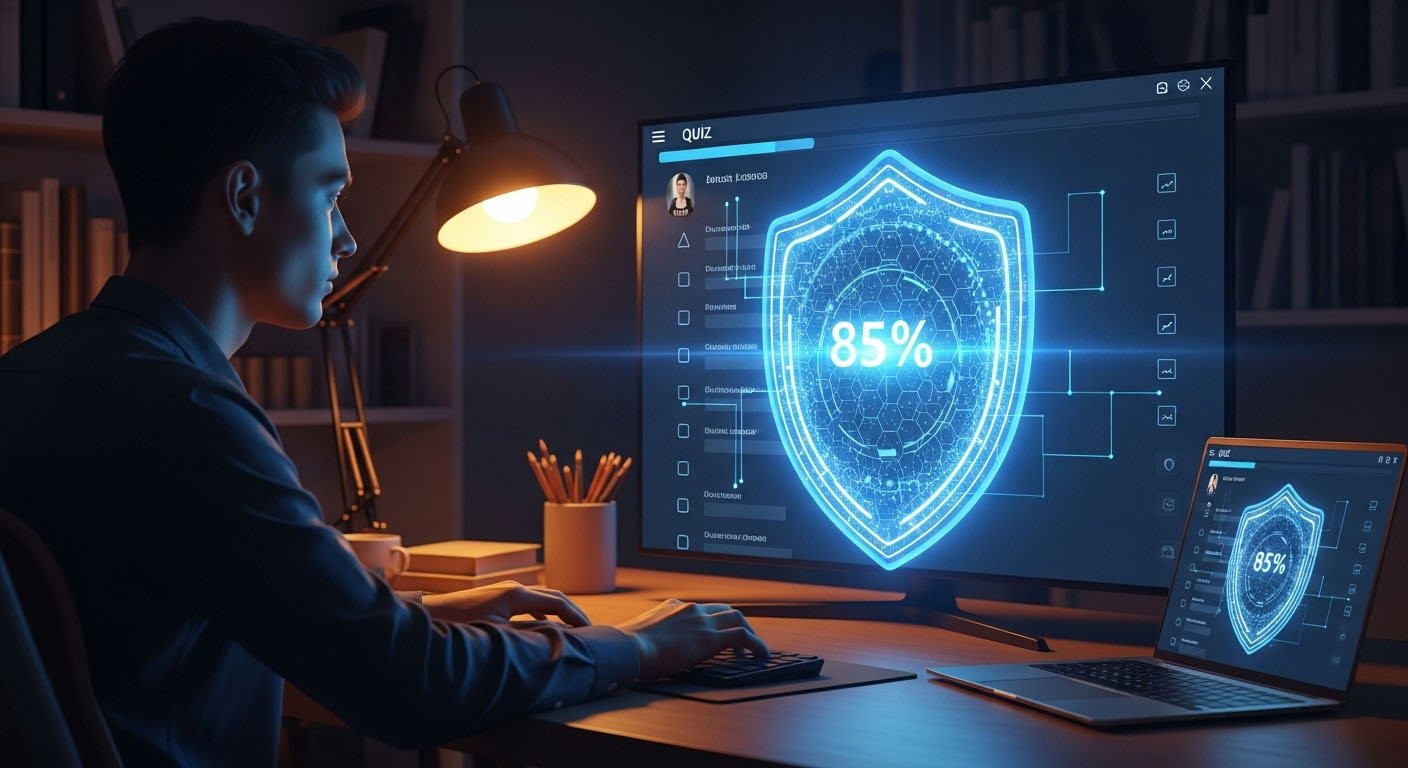
Quiz: Your AI Deepfake Vulnerability Score
The AI Deepfake Threat Score: Assess Your Vulnerability to the New Generation of Scams
The rapid advancement of generative artificial intelligence (GenAI) has fundamentally altered the landscape of cybersecurity, shifting the primary threat vector from traditional phishing emails to highly sophisticated synthetic media. This new generation of attack, known broadly as deepfakes, involves hyper-realistic videos, images, and audio fabricated using deep learning techniques.1 These creations are engineered to convincingly mimic real individuals, their actions, and their speech, effectively blurring the distinction between authentic and artificial content.1 This report establishes the scale of the threat, outlines the technical and psychological mechanisms of attack, and provides a critical vulnerability assessment model designed to fortify personal and corporate identity defenses.
Section 1: The Deepfake Tsunami: Defining the 2024-2027 Threat Landscape
The deepfake phenomenon is no longer a theoretical risk; it represents an industrialized threat achieving massive scale and driving catastrophic financial losses across global sectors. The data confirms a transition from niche cybercrime to a mainstream financial threat that is overwhelming current detection capabilities.
1.1. Deepfakes: Not Just Entertainment, But Industrial Fraud
While deepfake technology initially gained notoriety due to its application in non-consensual intimate imagery (NCII), which continues to constitute a distressing 96–98% of all online deepfake content, disproportionately victimizing women 2, the primary focus for sophisticated criminal enterprises has decisively shifted toward financial and corporate fraud. Since 2017, fraud has accounted for 31% of all reported deepfake incidents, leveraging synthetic identities to exploit weaknesses in banking and corporate transfer protocols.2
Deepfakes rely on neural networks to generate sophisticated media.1 Unlike simple digital manipulation, these synthetic artifacts are created by training AI models on large amounts of real data, allowing them to fabricate hyper-realistic content.1 The rapid accessibility of these tools has enabled malicious actors to operationalize the technology quickly and widely.4
1.2. The Viral Proliferation: Shocking Statistics and Financial Fallout
The growth trajectory of deepfake files signifies an exponential escalation, confirming that this threat is undergoing viral proliferation that surpasses nearly every other cyber security challenge.4 Deepfake files surged significantly, climbing from an estimated 500,000 shared across social media platforms in 2023 to a projected eight million by 2025.2 This increase translates to an astonishing 900% annual growth rate in the volume of deepfake videos, signaling the wide-scale adoption of generative AI tools by criminal networks.4
The corresponding increase in malicious activity is equally dramatic. Identity fraud attempts using deepfakes spiked by an incredible 3,000% in 2023 alone.2 Regionally, the scale of growth is staggering; North America, for instance, experienced a 1,740% growth in deepfake fraud between 2022 and 2023.2
This threat scalability carries a severe financial toll. In 2024, businesses globally incurred an average loss of nearly $500,000 per deepfake-related incident.2 For large enterprises, individual losses have been reported to climb as high as $680,000 per incident.2 Looking ahead, forecasts predict that fraud losses in the U.S. facilitated by generative AI will rise dramatically from $12.3 billion in 2023 to a projected $40 billion by 2027, demonstrating a compound annual growth rate of 32%.2 This forecast highlights the fact that the threat has achieved industrialized scale, necessitating industrialized defenses.
Table 1: Deepfake Fraud Growth and Financial Impact (2023-2027 Projections)
1.3. Case Files: How Multi-Million Dollar Deepfake Scams Execute
High-profile corporate attacks illustrate how perfect technical mimicry is combined with deep social engineering. These cases invariably succeed due to procedural and identity assurance failures.
The most devastating reported incident involved a staff member at a multinational firm in Hong Kong in 2024. This employee was deceived into executing 15 transactions totaling nearly $26 million (HK $200M).5 The fraud was perpetrated during a video conference call featuring deepfake impersonations of the company's Chief Financial Officer and several other employees.5 The perceived authenticity of the video call successfully bypassed internal controls, demonstrating a critical failure in corporate financial transfer protocols. The success of such a high-stakes attack confirms that effective defense must incorporate procedural safeguards that assume the identity is synthetic, given the low success rate of human detection.
A precedent-setting case occurred earlier, in 2019, when a U.K.-based energy company lost $243,000. In this scenario, a CEO was targeted by deepfake audio impersonating the executive of the parent company, who ordered an urgent transfer of funds to a fraudulent Hungarian supplier.6 This highlights that voice cloning is sufficient to facilitate large financial losses, especially when combined with tactics that create immediate urgency.8
Section 2: Decoding the Technology: How AI Creates a Perfect Imposter
Understanding the mechanisms of deepfake creation is essential for formulating effective defenses. The technology is rooted in advanced machine learning models that are continuously improving, making reliance on human discernment a flawed strategy.
2.1. The Engine of Deception: Generative Adversarial Networks (GANs) at Work
The backbone of deepfake technology lies in Generative Adversarial Networks (GANs), a sophisticated class of machine learning frameworks.9 A GAN operates based on an adversarial principle: two neural networks—a Generator and a Discriminator—are pitted against each other in a perpetual, competitive process.10
- The Generator: This network creates new synthetic data, such as a forged video or a cloned voice.9
- The Discriminator: This network evaluates the generated data, attempting to determine if it is fake or real.9
The Generator is trained not to minimize the distance to a specific image, but rather to fool the Discriminator.10 If the Discriminator successfully identifies the fake content, the Generator updates its parameters to create a better forgery. This continual competition forces both networks to improve until the resulting synthetic media becomes virtually indistinguishable from authentic content.9 Deep learning models, including Variational Autoencoders (VAEs), are also employed to learn the core facial or vocal characteristics (latent variables) necessary to reconstruct realistic variations of the target individual.11
2.2. The Accessibility Crisis: Why Voice Cloning is the Top Attack Vector
Voice cloning currently represents the top attack vector because it is simultaneously cheap, fast, and highly convincing.4 The barrier to entry for criminals is remarkably low. Scammers require only about three seconds of an individual’s voice—data easily available from public social media profiles or voice messages—to train an AI model.13 Investigations have shown that these tools can produce a clone with an 85% voice match to the original.14
The accessibility of this technology means that the threat can be scaled dramatically. Instead of hiring multiple people to conduct vishing attacks, fraudsters can now utilize generative AI tools and chatbots to automate the process, rapidly increasing the volume of potential victims.13
This perpetual improvement by generative technology highlights a fundamental security crisis: human detection is unreliable. For high-quality video, the human detection rate is only 24.5%.4 The consequence of this low success rate is profound: expecting human employees or consumers to reliably spot an AI-generated forgery is an unsustainable defense strategy. The procedural approach must shift to account for the certainty that deepfakes will eventually surpass human sensory detection capabilities.
2.3. The Psychological Weapon: Social Engineering Principles in AI Fraud
Deepfake technology gains its effectiveness when it is seamlessly integrated into established social engineering principles.15 The sophisticated deepfake voice or video is the vehicle, but the psychological manipulation is the propellant.
Deepfake vishing (voice phishing) relies heavily on tactics designed to induce panic and suspend rational judgment.8 Scammers often impersonate authority figures—such as CEOs, police officers, or bank staff—to leverage the victim's inherent respect for authority.8 Alternatively, they may impersonate a family member facing an emergency, exploiting powerful emotional ties.3
The most potent element in these attacks is the deliberate creation of urgency.8 The scammer pressures the victim to act immediately ("The funds must be transferred now," or "This is a critical, time-sensitive security issue").8 This cognitive overload is designed to bypass the victim's critical thinking, ensuring that verification protocols are ignored.3 This combination of flawless identity mimicry and high-pressure manipulation is what makes modern deepfake fraud so devastatingly effective against corporate treasury departments and vulnerable individuals.8
Section 3: The Deepfake Vulnerability Assessment Quiz
Given the confirmed failure rate of human detection, an effective risk assessment must move beyond asking, "Can you spot the fake?" and focus instead on evaluating inherent systemic and behavioral vulnerabilities. The Deepfake Threat Score assesses the procedural weaknesses and digital hygiene habits that deepfake attackers exploit before, during, and after an attack.
3.1. Introduction to the Threat Score: Why Human Vigilance is Failing
Research confirms that only 24% of consumers believe they can reliably spot a deepfake.17 Since the technology is explicitly designed to defeat the Discriminator (human or machine), the most effective defense is eliminating the opportunity for the attack to succeed. The score below assesses factors related to digital footprint exposure, crisis behavior, and identity verification practices.
3.2. The Deepfake Threat Score: Scoring Your Digital Hygiene and Behavioral Risk
The assessment focuses on four primary categories that correlate directly with exposure to deepfake fraud. For each category, individuals should assess their habits and procedures to understand their susceptibility level.
Table 2: The Deepfake Threat Score: Vulnerability Assessment Factors
3.3. Key Assessment Factors Detailed
3.3.1. Digital Footprint Exposure
The quality of a deepfake is entirely dependent on the quality and volume of training data available.13 Since the process requires only seconds of voice data for high-fidelity cloning, the amount of voice, image, and biographical information an individual makes publicly available online directly dictates their inherent risk level.3 High exposure provides the generative model with better source material and gives the social engineer the necessary personal context (PII, family details) to make the attack scenario believable.16
Reducing this exposure is a critical preventative measure, falling under the umbrella of foundational cyber hygiene. Adopting regular security practices, such as strong password management, frequent software updates, and data backups, safeguards the foundational digital assets that, if compromised, feed the deepfake identity theft funnel.21
3.3.2. Response to Urgency and Authority
Scammers recognize that even a flawless deepfake will fail if the victim adheres to rigorous verification protocols. The most common tool used to circumvent these protocols is the creation of artificial pressure or crisis.8 Vulnerability in this area is measured by an individual's tendency to suspend rational judgment when faced with high-stakes, urgent, or authoritative demands. Susceptibility to urgency tactics ensures that the high-quality deepfake, which bypasses sensory detection, is followed immediately by the transfer of funds, completing the fraud chain.
3.3.3. Identity Verification Practices
Deepfakes are now proficient at spoofing biometric data (face, voice) used for identity verification. Relying solely on static passwords or single-factor authentication (SFA) for critical systems leaves accounts exposed to easy takeover once the biometric or credential data is compromised.19 This factor assesses the use of Multi-Factor Authentication (MFA) and, increasingly, advanced mechanisms like biometric Liveness Detection, which provide an essential layer of security against the replication of identity data.18 By hardening the verification layer, a business can neutralize the success of even a perfect deepfake at the point of access.
Section 4: Advanced Defense Strategies: Moving Beyond Human Detection
Since the arms race between deepfake generation (GANs) and detection is technologically tilted in favor of the attacker, the most resilient strategy involves shifting from passive detection to active, procedural verification and technological fortification.
4.1. Procedural Resilience: The Mandate for Zero-Trust Verification
For individuals and organizations alike, the core defensive strategy must be centered on the Zero-Trust Architecture model: assume nothing, check everything, and limit access.18 This requires a philosophical shift from expecting employees or consumers to "detect and block" the deepfake to implementing protocols that "verify and confirm" the identity through independent means, regardless of how realistic the communication appears.20
This procedural resilience relies on mandatory multi-channel verification. Any request involving sensitive actions, particularly financial transactions or critical data disclosure, must be independently verified through a secondary, trusted communication channel.20 For instance, if an executive requests an urgent transfer via a deepfake video call, the employee must be trained to hang up and call the executive back on a known, verified phone number.18
A simple yet highly effective measure for family and corporate communications is the use of pre-arranged, out-of-band authentication measures, such as a secret phrase or code word.16 If the caller, regardless of the authenticity of their voice or image, fails to provide the pre-agreed phrase, the interaction must be immediately flagged as suspicious.16 This procedural requirement successfully bypasses the deepfake technology itself.
4.2. Implementing Multi-Layered Defense Protocols
Effective defense against industrial-scale deepfake fraud requires a multi-layered approach that addresses behavioral, authentication, and data integrity challenges simultaneously.
Table 3: Multi-Layered Defense Against Sophisticated Deepfake Attacks
4.3. Biometric Fortification: The Critical Role of Dynamic Liveness Detection
As deepfakes become more adept at generating synthetic faces and voices, traditional biometric authentication methods that rely on static input (like a simple face scan) are no longer sufficient. Liveness detection is a fundamental capability designed to confirm that the user is a real, physically present person interacting in real-time, preventing fraud using photos, presented videos, or injected deepfakes.19
However, the rapid escalation in attacker sophistication demands advanced techniques. Simple active liveness checks (e.g., asking the user to blink or nod) are vulnerable to sophisticated deepfake spoofing.19 The current state-of-the-art defense is Dynamic Liveness Detection, which uses proprietary technology, such as the patented Flashmark system, that transmits a unique light code to the device.23 The analysis of the light's reflection confirms physical presence and real-time interaction, providing advanced mitigation against deepfakes injected into the video stream.23 These complex AI algorithms analyze imagery and device signals to detect spoofing attempts, including the use of emulators, virtual cameras, and man-in-the-middle attacks.23 This continuous adaptation ensures that the security process remains resilient against novel threats.
4.4. Content Provenance: Tracking Truth via Digital Watermarks and Blockchain
For media platforms and content creators, the defense involves establishing verifiable authenticity at the source. Content provenance refers to the ability to track the origin and history of digital media. Technologies such as digital watermarks embed immutable markers within audio, video, or image data, confirming ownership and establishing a secure chain of authentication.18
The use of blockchain technology further enhances this integrity, utilizing its distributed and immutable ledger to counter manipulation.18 The rising legal necessity for provenance is reflected in proposed legislation, such as the DEEPFAKES Accountability Act, which specifically seeks to mandate the use of content provenance technologies that clearly identify any record containing altered audio or visual elements.25 This legislative shift pushes the burden of proof for content authenticity onto the creator and distributor, rather than the end consumer.
Section 5: Fortifying Your Digital Privacy and Identity
The successful deployment of a deepfake requires not only technical prowess but also enough contextual data to make the impersonation believable. Therefore, foundational digital privacy measures act as the first line of defense, starving the generative AI models of the data required for sophisticated targeting.
5.1. Minimizing Your Voice and Image Attack Surface
Since only three seconds of audio are needed to create a high-fidelity voice clone 14, proactive data minimization is crucial. Individuals must critically review their public digital presence, limiting the sharing of voice notes, publicly accessible videos, and detailed biographical information.15 Any public digital data can be captured and utilized by the AI models to refine their impersonations.
Furthermore, maintaining robust cyber hygiene—utilizing complex, unique passwords, securing data with multi-factor authentication (MFA), and applying timely software patches—reduces the overall risk of credential theft and account takeover, which often precede or follow deepfake identity theft.21
5.2. The First Line of Defense: Protecting Against Phishing and Data Exposure
Deepfake scams are often not random; they are highly personalized attacks built on harvested Personally Identifiable Information (PII).16 This necessary context—such as addresses, birthdays, employment details, and knowledge of family members—is frequently acquired through mass data leaks or targeted phishing emails.16 The phishing attempt acts as a gateway for attackers to gain the credentials or systemic access necessary to execute a deepfake social engineering attack.26
For interactions with unfamiliar or untrusted websites, using tools that enforce privacy and anonymity significantly reduces this risk. By creating a necessary layer of isolation, users can prevent exposure to phishing attacks, malicious tracking, and data mining, all of which contribute to the context used in sophisticated deepfake preparation.26
Using a disposable, temporary email address for non-critical registrations, content downloads, or trial requests dramatically limits the attack surface. If the temporary address is compromised or receives a phishing attempt, the primary, permanent email account and its associated personal data remain completely isolated and secure.26 This defense mechanism limits the probability of an attacker gathering sufficient contextual data to make a targeted, high-fidelity deepfake scenario successful. For a comprehensive guide on how disposable email fortifies your digital perimeter against spam, data mining, and targeted phishing, readers should refer to our detailed post on why you should(https://tempmailmaster.io/blog).26
5.3. Managing Secure Identities: The Role of Layered Authentication
Implementing robust identity and access management is crucial to limiting the ability of deepfakes to penetrate systems. By deploying Multi-Factor Authentication (MFA) and exploring advanced behavioral biometrics, organizations and consumers can enforce stronger access controls.18
The primary goal of deepfake fraud at the enterprise level is account takeover (ATO) to facilitate financial theft.19 By securing the point of authentication with layered security, particularly through dynamic liveness detection, fraudsters are prevented from replicating or spoofing a legitimate user's identity data, thereby mitigating financial damage before access is granted.19
Section 6: The Ethical and Legal Response
The societal risk posed by deepfakes requires a collective response that extends beyond individual defense protocols, encompassing new regulatory frameworks and ethical standards for generative AI development.
6.1. Legislative Efforts to Mandate Transparency
Governments are actively grappling with the regulatory vacuum surrounding synthetic media. The pervasive use of deepfakes for misinformation (such as the deepfake robocall impersonating President Joe Biden during the New Hampshire primary 5) and non-consensual harm has spurred legislative action.
In the U.S., proposed legislation such as the DEEPFAKES Accountability Act aims to introduce comprehensive transparency requirements for advanced technological false personation records.25 This act mandates clear disclosure requirements and the utilization of content provenance technologies to ensure that altered audio or visual elements are identified.25 The intention is to shift liability onto the creator for failing to disclose the synthetic nature of the media.
Furthermore, platform operators and content distributors are facing increased legal obligations to manage malicious deepfake content. Legislation like the TAKE IT DOWN Act mandates establishing accessible reporting mechanisms for victims and requires platforms to quickly remove flagged non-consensual intimate imagery, often within 48 hours.27
6.2. The Ethical Imperative: Accountability and Data Governance in GenAI
Generative AI presents profound ethical dilemmas related to manipulation, lack of accountability, and intellectual property.28 A foundational requirement for ethical AI practice is maintaining human agency and oversight. AI systems cannot be granted authorship because authorship implies responsibility and agency; thus, human creators must remain fully accountable for any AI-generated works, ensuring their accuracy, fairness, and compliance with copyright laws.29 Transparency is paramount, requiring clear labeling when content is AI-generated or AI-enhanced.27
Beyond output, the ethical governance of training data is critical. Generative AI models rely on massive datasets that often include personal, sensitive, or copyrighted information.28 Organizations must implement stringent data governance frameworks that establish clear policies for data collection, storage, and anonymization to prevent misuse for unethical purposes, including the creation of malicious deepfakes.28 The absence of comprehensive global regulation places the immediate responsibility on developers and organizations to ensure AI is used responsibly and ethically.
Valuable FAQs
Q1: What is the single most important defense against an AI voice clone scam?
A: The single most important defense is out-of-band verification.
Explanation: Since deepfakes are designed to be indistinguishable from a real voice, individuals cannot rely on the sound alone. It is imperative to stop, remain calm, and verify the request through a secondary, trusted channel, such as calling the person back on a known, verified number or utilizing a pre-agreed secret phrase.8 This procedure neutralizes the deepfake technology regardless of its sophistication.
Q2: How is modern deepfake fraud different from traditional vishing?
A: Modern deepfake fraud uses AI-generated voice clones to impersonate trusted individuals, making the attack far more convincing and harder to detect than traditional vishing, which used the scammer's real voice.8
Explanation: Deepfake vishing leverages Generative Adversarial Networks (GANs) and advanced voice cloning tools that require only seconds of audio input. This technical precision, combined with social engineering, allows for high-value fraud targeting corporate leadership and family members with devastating accuracy.3
Q3: Can dynamic liveness detection stop deepfake video calls?
A: Yes, dynamic liveness detection is highly effective against sophisticated video deepfakes.
Explanation: Unlike static authentication (blinking or smiling), dynamic liveness systems use patented technology (like Flashmark) and complex AI analysis to confirm the individual is physically present and interacting in real time. This blocks deepfakes injected into the system via emulators or virtual cameras, which often bypass simpler authentication layers.19
Q4: Why is minimizing my digital footprint a defense strategy?
A: Minimizing an individual's digital footprint reduces the quality and context available for an attacker to create a high-fidelity, convincing deepfake.
Explanation: Deepfake models require voice, image, or PII data to train their impersonations. By limiting public voice clips and image access, and using tools like temporary email to reduce data exposure, one starves the generative AI models of the data needed to make the attack hyper-realistic and targeted.13
Q5: What is the projected financial impact of generative AI fraud in the US by 2027?
A: Generative AI fraud losses in the U.S. are projected to reach $40 billion by 2027, up from $12.3 billion in 2023.2
Explanation: This projection, calculated by the Deloitte Center for Financial Services, represents a 32% compound annual growth rate (CAGR), reflecting the industrial-scale operationalization of deepfake technology across corporate and consumer finance sectors.4
Conclusion: Securing the Future of Identity
The deepfake threat represents a new frontier in cybercrime, characterized by explosive volume growth, industrialized deployment, and technological capabilities that render human detection largely irrelevant. The analysis of major financial losses, such as the $26 million corporate scam, demonstrates that these attacks are fundamentally successful because they exploit procedural gaps and behavioral vulnerabilities, not just technological weaknesses.
To secure identity in the age of synthetic media, individuals and organizations must embrace systemic change. The strategic focus must shift away from the flawed concept of human vigilance and toward robust, integrated procedural and technological defense architectures. This includes implementing Zero-Trust verification protocols that mandate multi-channel confirmation for sensitive actions, fortifying access points with sophisticated dynamic liveness detection to counter biometric spoofing, and adopting strong digital hygiene practices like data minimization and the use of identity isolation tools to starve deepfake models of necessary contextual data.
The future of digital safety depends on recognizing that technology capable of generating reality-bending media demands defense strategies that function even when the forged identity appears flawless. By emphasizing verification, procedural resilience, and data integrity, organizations and consumers can proactively assess and reduce their Deepfake Threat Score, building robust safeguards against the escalating wave of AI-driven fraud.
Written by Arslan – a digital privacy advocate and tech writer/Author focused on helping users take control of their inbox and online security with simple, effective strategies.