Hyper-Disposable Domain Index Report
Report: The Hyper-Disposable Domain Index (H1 2026 Fraud Trends)
I. Executive Summary: The Velocity of Deception in H1 2026
1.1. Introduction to the Hyper-Disposable Threat Landscape
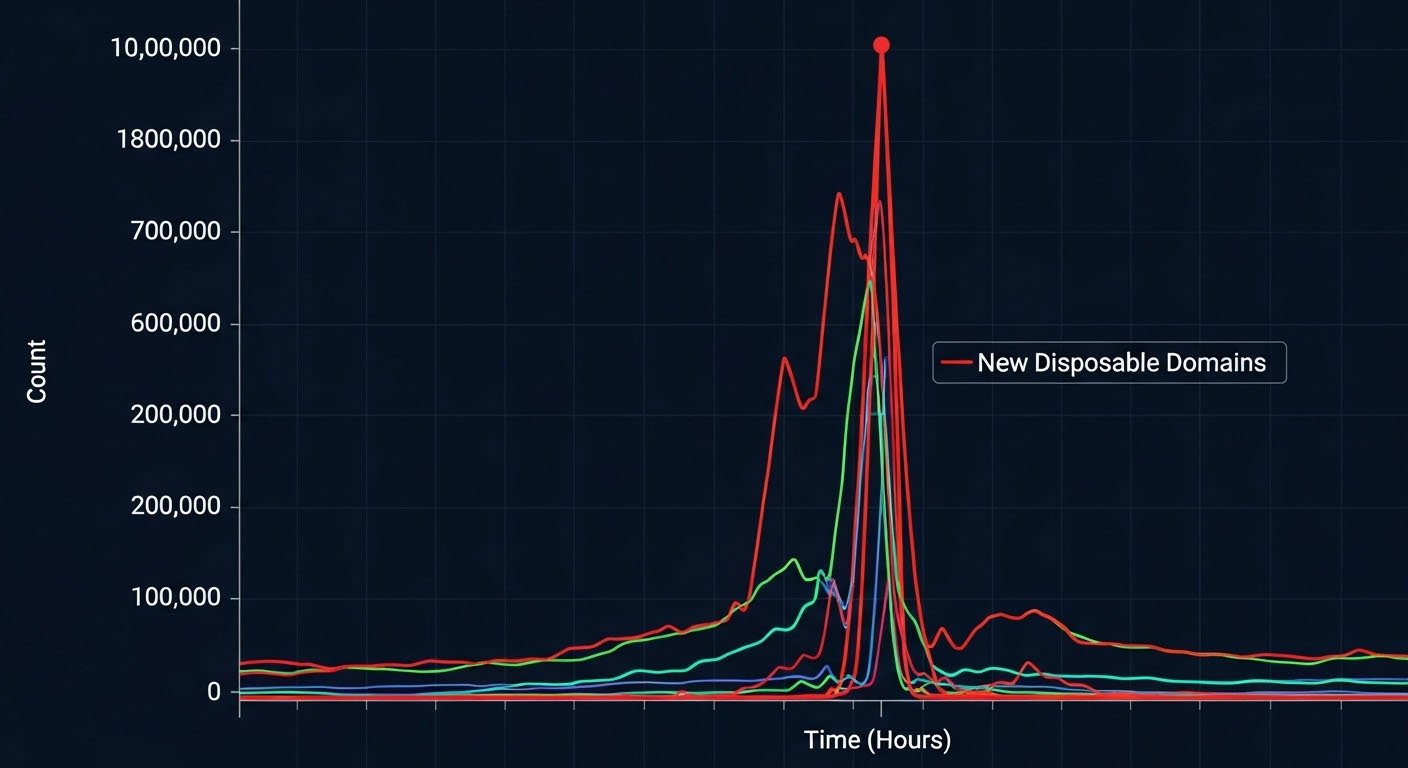
The digital trust ecosystem currently faces an escalating crisis driven by the convergence of powerful Generative AI capabilities and a novel, fleeting infrastructure known as Hyper-Disposable Domains (HDDs). The fraud landscape in the first half of 2026 (H1 2026) has transitioned decisively from opportunistic, manual attacks to sophisticated, industrialized, and automated campaigns, characterized primarily by an unprecedented level of speed, volume, and evasion.1
This shift has created a fraud environment where older detection models are failing. Generative AI provides the scale to create millions of plausible synthetic identities, and the Hyper-Disposable Domain acts as the linchpin for this new level of threat. HDDs provide fraudsters with untraceable, high-volume sign-up endpoints necessary to bypass traditional defenses that were designed to counter conventional disposable email services.2 The critical analysis of fraud evolution reveals a clear escalation: as basic spam evolved into disposable email domains, the advent of AI-augmented fraud necessitated the creation of infrastructure that could match the technological velocity of the attack engine. The HDD is not merely an auxiliary tool; it is the fundamental infrastructure required to enable industrialized, AI-scale account abuse.3 This acceleration in fraud velocity is the core constraint driving the adoption of the HDD model.
1.2. Key Findings and Immediate Business Imperatives
The immediate fallout of this trend is multifaceted, posing critical challenges to measurement, finance, and security:
- Metric Corruption: Fraudulent sign-ups are actively destroying the integrity of crucial growth indicators. Analysis confirms that account creation remains the highest risk stage in the consumer lifecycle, with 8.3% of all digital account creation attempts in H1 2025 suspected of fraud.5 HDDs accelerate this systemic problem by providing untraceable sign-up endpoints for mass automated attacks, enabling bots to flood onboarding funnels and skew analytics.3
- Domain Obsolescence: HDDs are fundamentally defined by their lack of persistence. These domains are designed with extremely brief existences, typically lasting less than 7 days, a stark contrast to the weeks-long lifespan of conventional disposable domains.4 This transient nature effectively renders static blocklists and rudimentary rules-based systems entirely ineffective, as the malicious domain vanishes before it can be categorized and actioned.6
- Adaptive Defense Mandate: Given the speed of evasion, reliance on known bad domains is unsustainable. Organizations must immediately pivot away from static defense mechanisms toward a layered, predictive defense architecture. This requires utilizing adaptive machine learning and real-time behavioral analysis. The focus must shift to detecting malicious intent and velocity, rather than simply relying on lists of known bad addresses. Fraud solutions must therefore prioritize velocity analysis and the lack of domain age as core, high-priority risk signals, moving the defense mechanism from reactive to predictive.6
II. The Genesis of the Crisis: Defining Hyper-Disposable Domains (HDDs)
2.1. Disposable Domains 1.0 vs. Hyper-Disposable 2.0: A Critical Distinction
To understand the current crisis, it is essential to establish a precise technical distinction between legacy disposable domains and their hyper-disposable successors.
Conventional Disposable Domains (TDDs) operate through known, often publicly listed providers that allow temporary use. While intrinsically high-risk, these domains commonly persist for several weeks. This duration provides security researchers and automated systems a limited but functional window of opportunity to detect, blacklist, and mitigate their impact effectively.4
Hyper-Disposable Domains (HDDs), conversely, represent a far more sophisticated and targeted threat. They are designed specifically for single-use or extremely short-term, high-volume activity with the intent to evade traditional detection methods.2 HDDs distinguish themselves from TDDs through two critical operational characteristics that define their malicious utility:
- Extremely Short Lifespans: These domains are intentionally transient, typically existing for just a few days, often less than 7 days in total. This creates a minimal, fleeting window for security teams to act or systems to flag the activity.4
- Mass Generation: Fraudsters have developed industrialized processes that leverage automation to mass-produce HDDs in extremely high volumes. This ensures a continuous, fresh supply of untainted domains ready for use in scripted campaigns.4
The current threat analysis indicates that these fleeting domains now represent approximately 46% of all identified high-risk disposable domains.11 This volume confirms that transient, fast-moving infrastructure is becoming the default choice for large-scale automated fraud operations.
2.2. The Mechanism of Evasion: How Transience Neutralizes Defense
The success of HDDs stems directly from the temporal advantage provided by their high speed of obsolescence, which neutralizes defense mechanisms designed for slower, more stable threat environments.
The rapid obsolescence of HDDs means that static blocklists of disposable email providers are instantly outdated upon publication.6 By the time a security analyst identifies a domain, researches its origin, and registers it onto a shared blocklist, the domain has likely already completed its short lifespan, served its fraudulent purpose, and been abandoned by the malicious actor.7 This process leaves a narrow window for detection, complicating user verification processes that rely on established domain reputation or historical risk scoring to vet new sign-ups.4
Because a domain's typical lifecycle is less than seven days 4, reliance on pre-compiled lists is a losing defensive strategy. This reality establishes the domain’s age—or lack thereof—as the single most critical indicator of high risk. Anti-fraud systems must therefore prioritize real-time Domain Age Analysis. A domain created within the last 72 hours, particularly when coupled with high-volume sign-up attempts, should be automatically scored as critically high risk, regardless of whether it currently appears on a known blocklist.
Fraudsters exploit this temporal advantage across key attack vectors:
- Mass Account Creation: HDDs enable the generation of large numbers of fake accounts in bulk, allowing them to manipulate incentive systems, exploit promotions, or perform credential stuffing validation at scale.1
- Phishing and Traceability: The anonymity provided by HDDs means they are used as untraceable contact points for sophisticated phishing campaigns. Once the attack is executed, the email address is quickly discarded, making it extremely difficult for investigators to trace the perpetrators or the origins of the financial fraud.12
III. The AI Accelerator: How Generative LLMs Industrialize Fraud
3.1. Scaling Synthetic Identities: From Spam Bots to Digital Clones
Generative AI (GenAI) and Large Language Models (LLMs) have fundamentally reshaped the fraudster's methodology, shifting attacks from basic, recognizable scripts toward highly personalized, human-like engagement.14 This technology provides the scale and quality necessary to launch industrial-level fraud operations.
AI is now extensively used to generate entirely synthetic digital identities and the compelling narratives required to execute sophisticated fraud schemes.15 Fraudsters utilize generative models to:
- Create Plausible Personas: Produce deepfake profile pictures that appear legitimate and pass initial verification checks.16
- Mimic Human Interaction: Generate realistic bios, activity patterns, and engagement histories that convincingly mimic real user behavior, enabling bots to blend undetected into digital platforms.16
- Fabricate Documents: Create realistic fake supporting documents, such as bank statements or utility bills, facilitating complex synthetic identity fraud during rigorous, multi-step verification processes.14
LLMs are particularly effective in structured, low-context conversational scenarios, making them perfectly suited for the initial outreach stages of scams.17 This has drastically increased the efficiency of malicious campaigns by generating sophisticated phishing communications with significantly improved grammar and natural, realistic language, making them much harder for human victims to spot.18
The volume of AI-generated scam emails saw a significant spike, peaking at 51% in April 2025, confirming the rapid and mainstream adoption of AI by malicious actors.20 This massive flow of high-quality, personalized phishing content relies on HDDs as the scalable, untraceable communication layer for attacks such as Business Email Compromise (BEC) and personalized phishing campaigns, which account for massive financial losses annually.11
3.2. Automated Evasion Techniques
The sheer scale of AI-generated identities requires automated tools to bypass standard verification checkpoints. Fraudsters combine the transient nature of HDDs with highly sophisticated evasion mechanisms:
- OTP Bots and Vishing: Attackers deploy AI-powered bots that leverage complex scripts to initiate phone calls (vishing) or send texts, tricking victims into verbally sharing One-Time Passwords (OTPs) needed to complete account verification or takeover attempts.22
- Scripted Behavioral Automation: Modern bots are carefully programmed to mimic human behavior, utilizing techniques such as simulating mouse movements, erratic scrolling, and natural typing cadence. They often use specialized anti-detect browsers and automated frameworks to evade behavioral analysis layers that look for unnatural, perfect consistency.23
- Network Obscuration: Fraudsters utilize rotating IP proxies and virtual phone numbers (like those sourced from specific services) to ensure that each mass sign-up attempt appears to originate from a unique, legitimate source. This tactic successfully bypasses standard IP and network intelligence checks designed to flag repeated attempts from the same location or device cluster.25
The convergence of AI and HDDs means that email verification has transcended a simple technical check of deliverability; it is now a crucial identity assurance measure being directly attacked. If a fraudster can create a perfect synthetic profile via LLM 14 and use an HDD to receive the verification link 4, the final necessary hurdle is the OTP or two-factor authentication (2FA). AI-powered OTP bots directly target this weakness, effectively closing the loop on fully automated identity theft and Account Takeover (ATO).22 This complex threat environment necessitates that identity verification tools validate the controlling party of the email, mitigating the risk posed by credentials that are borrowed, stolen, or disposable.11
IV. The Financial Entropy: Quantifying the Distortion of CAC and CLTV
The massive infiltration of HDD-driven, zero-value accounts introduces a state of Financial Entropy into core business growth metrics. This corruption renders key performance indicators (KPIs) unreliable, leading to flawed scaling strategies and significant misallocation of capital.
4.1. The Inflated Customer Acquisition Cost (CAC)
Fraudulent bot traffic represents a critical, often hidden, drain on marketing and operational budgets. Analysis shows that bot-driven traffic accounted for 30% of total worldwide ad spending in 2024, leading to billions wasted globally.27
The distortion of Customer Acquisition Cost (CAC) is structural and subtle. CAC is calculated by dividing total acquisition spend (which includes marketing expenses, software, and staff wages) by the total number of customers acquired.29 When HDDs are used to generate mass fake sign-ups, the denominator—the count of "customers acquired"—is artificially and dramatically inflated.30
This inflation results in a calculated CAC that appears deceptively low, painting a false picture of high marketing efficiency and cost-effective customer acquisition. In reality, the true Cost per Valuable Customer (CPVC) is drastically higher. This faulty metric leads management teams to mistakenly increase investment in channels that generate prolific but ultimately non-productive traffic.31 The hidden consequence includes wasted funds on non-converting ad clicks, administrative costs for sending expensive onboarding emails to ghosted inboxes, and significant server and engineering overhead wasted on maintaining useless user profiles.30
4.2. The Corroded Customer Lifetime Value (CLTV)
HDDs are predominantly used to create "zero-value users." These are accounts created strictly to exploit a temporary economic advantage—such as a free trial, referral bonus, or limited-time discount—with no intention of purchasing or engaging long-term.30 These zero-value users typically abandon the hyper-disposable email address and churn immediately after exploitation.
The distortion of Customer Lifetime Value (CLTV) is a direct consequence of this mass churn. CLTV measures the average revenue or profit a customer generates throughout their relationship with the business.34 When thousands of zero-value users (who generate zero profit) are averaged into the overall customer base calculation, the perceived CLTV for the entire business drops dramatically.30
This mathematical corruption is strategically devastating: a declining LTV/CAC ratio signals a fundamentally unprofitable business model to investors and internal stakeholders.36 Fraud effectively makes the company appear less profitable and efficient than it actually is, hindering crucial fundraising, capital allocation, and strategic investment decisions.37
The operational risk is further amplified by a flawed feedback loop: high sign-up volume (driven by HDDs) generates a misleadingly low CAC, which prompts management to scale the budget for the fraudulent channel. This scaling then acquires more fake users, further polluting the data, until the financial reality of zero LTV exposes the failure, but only after substantial capital has been wasted.36 The core issue is the loss of data integrity, which corrupts capital allocation.
Table 2: Fraud Impact Matrix: Quantifying HDD Distortion on Business Metrics
4.3. Hidden Operational and Compliance Drag
Beyond immediate financial losses, low-quality sign-ups impose significant operational burdens. Fake accounts pollute critical analytics and skew conversion reporting. Business decisions made based on this contaminated data—such as product-market fit or conversion funnel optimizations—are fundamentally flawed.30 Furthermore, fraudulent accounts, especially those linked to synthetic or illicit identities, expose organizations to regulatory and compliance risks, particularly in sensitive data industries governed by KYC (Know Your Customer) and AML (Anti-Money Laundering) regulations.11
V. Architecting the Defense: Multi-Layered Strategies for Mitigation
To effectively combat the velocity and sophistication enabled by HDDs and AI-driven fraud, organizations must abandon reliance on single-point solutions and instead adopt a resilient, multi-layered defense architecture.
5.1. Moving Beyond Static Blocklists: The Need for Adaptive Intelligence
Traditional blocklists are inherently reactive and too slow to be effective against domains that rapidly disappear.6 The defense strategy must transition to real-time adaptive intelligence. Solutions must utilize advanced machine learning (ML) trained on billions of signals to identify and block these transient domains.4 The strategic priority shifts toward predictive risk scoring based on current domain behavior rather than relying on historical data. This strategy emphasizes real-time Domain Age Analysis, Creation Velocity Tracking, and Real-Time IP/Network Intelligence as indispensable tools.6
Furthermore, advanced fraud detection systems increasingly integrate Graph Neural Networks (GNNs). GNNs are critical for mapping the complex relationships between potentially fraudulent entities—including users, compromised devices, and flagged HDDs—allowing security teams to identify coordinated "fraud rings" even when individual sign-ups utilize rotated infrastructure to appear legitimate.8
5.2. Behavioral Biometrics and Velocity Analysis
Since AI bots are deliberately engineered to mimic human input and behavior 16, detection methods must focus on identifying subtle, non-human anomalies within the interaction flow:
- Velocity Rules: These are essential for detecting unnatural activity spikes, such as automated mass account creation or repeated, frequent actions originating from a single source or closely related cluster of IP addresses.23
- Behavioral Analysis: Systems monitor fine-grained behavioral biometrics, including mouse movements, scrolling patterns, typing cadence, and session timing. Bots, even sophisticated ones using headless browsers, often exhibit patterns of perfect consistency or unnatural speeds that human users cannot physiologically maintain.23
- Device Fingerprinting: Gathering non-identifiable data from a user’s hardware and software configuration helps detect instances of spoofed or reused setups, which are hallmarks of bulk fraud farms designed to evade detection by mimicking legitimate users.23
Effective layered defense does not just block attacks; it significantly increases the economic cost and technical effort required for the fraudster.40 By forcing the attacker to constantly re-tool proxies, generate new HDDs, and slow down automation, the economies of scale that favor AI-driven fraud are strategically broken.
5.3. Implementing Robust Email Hygiene and Identity Assurance
A robust security posture requires stringent identity verification procedures:
- Mandatory OTP Email Verification: Requiring a One-Time Password (OTP) sent to the registered email address is a powerful deterrent. This simple step forces the user (or the bot managing the campaign) to prove active control of the inbox, which effectively disrupts bulk automated sign-ups and multi-accounting schemes.11
- Email Authentication Protocols: Enterprises must rigorously enforce email hygiene best practices to mitigate AI-enhanced Business Email Compromise (BEC) and phishing. This includes correctly configuring Sender Policy Framework (SPF), DomainKeys Identified Mail (DKIM), and Domain-based Message Authentication Reporting and Conformance (DMARC).41 Furthermore, the universal adoption of Multi-Factor Authentication (MFA) is crucial to secure accounts and prevent Account Takeover (ATO).43
5.4. The Comprehensive Layered Fraud Detection Framework
The most effective strategy against HDDs integrates multiple, consecutive controls throughout the customer onboarding journey, shifting defense priority from static perimeter checks (WAFs, blocklists) to the core identity layer (behavioral and domain intelligence).8
Table 3: Multi-Layered Defense Architecture Against HDD Fraud
VI. The Paradox of Temporary Email: Protecting Users While Blocking Scams
The discussion surrounding Hyper-Disposable Domains must be conducted with the nuance required to acknowledge the essential role of temporary email services for legitimate, privacy-conscious users. An overly strict response risks compromising user privacy and alienating valuable customers.
6.1. Legitimate Rationale for Temporary Email Usage
While fraudsters misuse temporary email for enhanced anonymity 13, legitimate users rely on services like Temp Mail to safeguard their identity and primary inbox from unwanted commercial correspondence, data harvesting, and the fallout of data breaches.46 The primary benefits for genuine users include:
- Enhanced Privacy and Anonymity: Temporary emails require no registration, strip personal details, and remove associated IP addresses after expiration, securing anonymity for non-critical sign-ups.46
- Effective Spam Mitigation: Users employ these addresses to sign up for forums, access one-time downloads, or subscribe to newsletters from less trusted sites, ensuring their main inbox remains clean and spam-free.47
- Tracking Data Disclosure: Disposable addresses function as effective tools for users to monitor whether a specific website owner has disclosed or breached their email address, providing an early warning system for identity risks.47
For users seeking robust privacy without relying on external services, utilizing email aliases or subaddressing (e.g., adding suffixes like "+spamfilter" to a primary address) offers a safer alternative with better personal control.48 (To learn more about advanced user techniques, read our guide on how to leverage email aliases for superior privacy protection: [advanced-spam-protection-using-email-aliases-for-privacy]).
Temporary email services also provide indispensable tools for developers and quality assurance teams who require secure, spam-free integration for application testing, as documented in various API specifications.50 (Explore how developers utilize these platforms effectively in our resource: [using-temp-mail-apis-for-development-and-testing]).
6.2. Distinguishing Legitimate Temporary Mail from Malicious HDDs
The dilemma for businesses involves the risk of "false positives." Businesses that implement overly stringent blocking policies targeting all disposable domains risk turning away legitimate, privacy-conscious customers, which results in false declines and a reduction in the potential Customer Lifetime Value from genuine users.51 False declines insult and exhaust users, curtailing their potential long-term spending.51
The key to navigating this dilemma is the ability to differentiate between known, stable temporary mail providers—whose domains are generally long-lived and associated with user privacy—and HDDs, which are intentionally ephemeral infrastructure designed exclusively for high-velocity malicious use.53
Businesses must adopt a nuanced, risk-based approach rather than outright blanket blocking. Utilizing the predictive Layer 2 ML models allows fraud detection systems to differentiate effectively between domains associated with long-standing privacy services and high-risk HDDs exhibiting malicious velocity signals.
Users must also be aware of the inherent risks of certain public, low-security temporary mail services. Many basic services lack encryption, and some public inboxes can be reused or shared openly, allowing attackers to hijack them for impersonation or account resets if the user mistakenly uses the service for a crucial sign-up.52 (Understand how to choose the right temporary service and avoid these risks in our detailed article: [is-my-temporary-email-truly-private-the-risks-of-public-disposable-inboxes]).
VII. Valuable FAQ's: Defense Against Hyper-Disposable Threats
1. What is the fundamental difference between a Disposable Email Address (DEA) and a Hyper-Disposable Domain (HDD)?
A: DEAs, or Traditional Disposable Domains (TDDs), refer to email addresses from providers that allow temporary use, often lasting weeks or months, primarily for user privacy or spam avoidance.46 HDDs are a subset of high-risk DEAs characterized by an extremely short lifespan, typically less than 7 days, and the ability to be mass-produced in high volumes.4 HDDs are engineered specifically to evade detection by rapidly disappearing before traditional blocklists can update and register the domain as malicious.6
2. How do HDDs directly impact my CAC and CLTV metrics?
A: HDDs fuel mass account creation by automated bots, which inflates sign-up figures and wastes marketing budget on non-converting traffic, thereby artificially lowering and inflating your calculated CAC.27 Simultaneously, these zero-value accounts are used solely to exploit free services or promotions and then immediately churn. This introduction of non-profitable accounts causes your average CLTV to plummet, resulting in a corrupted LTV/CAC ratio that provides inaccurate signals of future business profitability.30
3. Why are traditional blocklists ineffective against H1 2026 fraud trends?
A: Traditional blocklists are designed to be reactive, relying on the identification and logging of known malicious domains. Since HDDs are purposefully designed to exist for extremely short durations—often just a few days—they become obsolete faster than any blocklist can be compiled, disseminated, and deployed into active systems.6 Attackers can rotate through thousands of these transient domains faster than systems can adapt, rendering static defenses useless against the current velocity of fraud.2
4. What is the single most effective defense against HDD-driven mass account creation?
A: The most effective defense requires a proactive shift from static checks to real-time, adaptive machine learning models that analyze domain metadata, such as Domain Age Analysis and Creation Velocity.6 This must be complemented with a mandatory, high-friction identity measure during onboarding, specifically One-Time Password (OTP) Email Verification, which forces the attacker to prove active control of the inbox and instantly deters bulk automated sign-ups.11
5. How are Large Language Models (LLMs) contributing to the rise of HDDs?
A: LLMs provide the essential scale and sophistication necessary for industrialized, modern fraud. They are used to generate high-quality synthetic identities, produce hyper-realistic phishing content with perfect grammar, and create complex conversational scripts.14 This massive, automated generation of fake personas requires an equally scalable and untraceable communication infrastructure, which HDDs provide, completing the automation of the entire fraud supply chain.1
6. If temporary email services are used by fraudsters, should we block all of them?
A: Blocking all temporary email addresses is strongly discouraged. Such an aggressive policy carries a high False Positive risk, turning away legitimate users who rely on these services for essential privacy and spam protection.48 Instead, businesses should utilize predictive risk scoring systems (Layer 2) that can accurately differentiate between known, reputable, privacy-focused services and high-risk HDDs exhibiting signals of malicious velocity, thereby minimizing false declines and protecting potential high-LTV customers.6
VIII. Conclusion and The H2 2026 Outlook: Future-Proofing Digital Trust
7.1. Recapping the New Fraud Calculus
The H1 2026 fraud landscape is irrevocably defined by the fusion of high-velocity AI automation and the transient infrastructure of Hyper-Disposable Domains. This unprecedented partnership creates a systemic challenge to digital identity assurance and sustainable financial planning, resulting in projected annual financial losses contributing to the billions observed globally.4 The primary casualty is the loss of data integrity, where fraudulent sign-ups destroy the reliability of CAC and CLTV, forcing executives to base critical scaling and investment decisions on fundamentally flawed metrics.
7.2. Strategic Recommendations for H2 2026
To secure digital platforms and ensure that growth is built upon genuine, high-value customer relationships, organizations must adopt strategic measures designed for the accelerated threat environment of H2 2026:
- Invest in Intelligence, Not Lists: Redirect investment from outdated, static blocklisting tools toward predictive, adaptive machine learning models and sophisticated Graph Intelligence technologies. These systems must be capable of identifying patterns, relationships, and the velocity of abuse in real time, shifting the defense mechanism from reactive monitoring to proactive interception.38
- Harden the Funnel: Implement mandatory, real-time identity assurance measures at the point of sign-up. This includes layered defenses such as OTP email verification and behavioral biometrics analysis to significantly raise the technical barrier to entry for AI-driven automated attacks.11
- Prioritize Email Hygiene: Enterprise security protocols must maintain rigorous internal and external email hygiene practices. This includes the mandatory enforcement of robust email authentication protocols (DMARC, DKIM, SPF) and continuous security awareness training for all employees to mitigate the growing threat of AI-enhanced phishing, spoofing, and Business Email Compromise (BEC) risks.42
7.3. The Future of Digital Trust
Maintaining digital trust and profitability in H2 2026 will critically hinge on a business’s ability to move at the speed of fraud. The window for reactive defense has decisively closed. By proactively integrating a multi-layered security architecture that is designed for perpetual learning and real-time adaptation, organizations can safeguard their digital platforms, protect their financial integrity, and ensure that their growth story is accurately built upon genuine customer engagement, rather than corrupted data driven by zero-value threats. This adaptive defense model is essential for long-term operational resilience in the age of industrialized AI fraud.
Written by Arslan – a digital privacy advocate and tech writer/Author focused on helping users take control of their inbox and online security with simple, effective strategies.