Ethical Data Exchange & GDPR Enforcement
Ethical Data Exchange: How Temporary Email Enforces User GDPR Rights
Introduction: Reclaiming Digital Sovereignty – The Data Subject as Regulator
The architecture of the modern digital economy is fundamentally rooted in the mass collection, retention, and perpetual monetization of personally identifiable information (PII). This dynamic has created a significant dilemma for the contemporary consumer: one must often sacrifice deep-seated privacy protections to gain access to essential or highly desired digital services, software trials, and online content. This pervasive collection model traps individuals in a cycle where they must either consent to the indefinite retention of their long-term digital identifiers or forgo valuable utility.
This situation necessitates a shift in perspective, moving beyond passive compliance and towards defining the parameters of Ethical Data Exchange. An ethical exchange framework requires individuals to possess not only the right to grant consent but also the concrete tools to actively restrict data flow and precisely define the lifespan of their digital identity exposure.1 This moves the locus of control from the data collector back to the data subject.
The expert analysis confirms a central hypothesis: temporary email, particularly when adopted through advanced, secure alias systems, functions as an unprecedented consumer-side regulatory instrument. By utilizing this technology, individuals translate the abstract, complex principles of the General Data Protection Regulation (GDPR)—specifically Data Minimization, Purpose Limitation, and Storage Limitation—into concrete, immediately enforceable actions. This mechanism empowers the data subject to step forward as the primary regulator of their digital identity, achieving compliance goals that regulatory bodies often struggle to enforce quickly or efficiently.
The deployment of user-side tools fundamentally changes the interpretation of "Privacy by Design" (PbD). While PbD legally mandates that organizations build data minimization into their processing systems 1, secure aliases allow the user to execute that minimization proactively, regardless of the service provider’s default design. If a service demands an email address, the user provides a minimal, temporary proxy ID. This action ensures that the data collection is minimal at the point of input, initiating a profound shift in control dynamics toward the individual.2
Section 1: The Foundational Pillars of GDPR and Mandated Minimization
The General Data Protection Regulation (GDPR) established a rigorous framework for how personal data must be processed within the European Union, setting a global standard for data rights. Central to this framework are the seven core principles articulated in Article 5(1) 4, which define the fundamental legal obligations of all data controllers. Processing is permissible only if it rigorously adheres to these seven principles.
1.1. Article 5: The Seven Principles of Lawful Processing
Among the seven pillars, several are especially relevant when assessing the enforcement capabilities of temporary email systems:
- Lawfulness, Fairness, and Transparency: This principle demands that data processing be clearly communicated, predictable, and justifiable on a legal basis.4 Temporary email enhances fairness by ensuring that the user is not unwittingly coerced into long-term tracking or indefinite retention schemes.
- Accountability (Article 5(2)): Article 5(2) places the responsibility squarely on the controller to be able to demonstrate compliance with all aspects of Article 5(1).4 When an individual intentionally provides a secure, self-controlled alias, the scope of the data collected is already restricted. This inherently reduces the controller’s overall data retention footprint, thereby simplifying the demonstration of accountability regarding the minimal dataset they hold.
1.2. Deep Dive into Data Minimization (Article 5(1)(c))
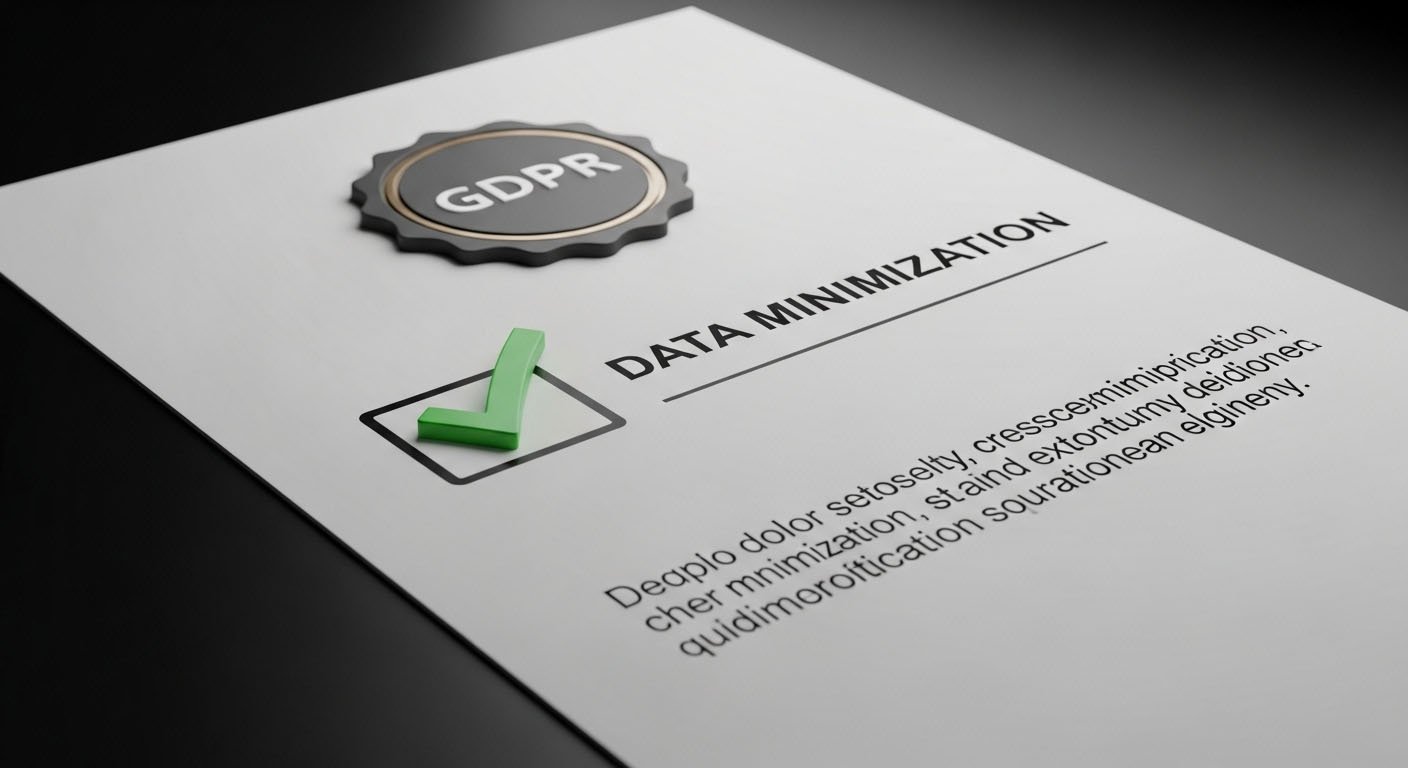
The Data Minimization principle is perhaps the most crucial element enforced by temporary email usage. Article 5(1)(c) explicitly states that personal data must be "adequate, relevant and limited to what is necessary in relation to the purposes for which they are processed".4
The critical interpretive challenge of this principle lies in defining "necessity." Data controllers often interpret necessity broadly to permit maximum data collection for future monetization or unforeseen purposes. Temporary email offers a user-centered, restrictive definition of necessity. For example, if a user requires access solely for a one-time document download or a brief trial, providing a short-lived alias is inherently "necessary" and adequate for that limited purpose. Conversely, the provision of a primary, lifetime email address, which serves as a cross-platform identifier, is demonstrably excessive and disproportionate to the stated purpose.6
Regulators legally expect controllers to operationalize minimization.6 However, the strong business incentive to collect maximal data often creates a divergence between regulatory expectation and practical corporate reality. The use of temporary email effectively closes this gap by allowing the consumer to enforce minimization preemptively. The consumer proactively limits the PII footprint before collection occurs. For consumers seeking control over their PII exposure, incorporating alias systems is an essential step that can be reviewed further in resources focused on digital identity minimization (e.g., resources discussing /guide-to-digital-identity-minimization).
1.3. Purpose Limitation (Article 5(1)(b)): Curbing Scope Creep
Purpose Limitation, stipulated in Article 5(1)(b), requires that data be collected for "specified, explicit and legitimate purposes" and explicitly prohibits further processing incompatible with those purposes.4
The permanent email address is widely regarded as the single most critical identifier that facilitates "purpose creep." A user signing up for a free trial using their primary email may inadvertently consent to receiving perpetual marketing, behavioral profiling, and data sharing with potentially dozens of third parties.8 The primary email address acts as a universal link, enabling incompatible processing activities that exceed the original, stated purpose.
Temporary email functions as a vital tool for purpose segmentation. By generating a unique, site-specific alias, the user explicitly compartmentalizes the purpose of the data exchange. If the user creates an alias intended solely for a specific vendor's newsletter, any subsequent use of that alias for profiling or transmission to an unrelated marketing partner constitutes a transparent violation of the explicit purpose tied to that segmented identity.
1.4. Storage Limitation (Article 5(1)(e)): The Expiry Mandate
The principle of Storage Limitation dictates that personal data must be "kept in a form which permits identification of data subjects for no longer than is necessary for the purposes for which the personal data are processed".4
This legal requirement finds its natural, functional counterpart in the mechanisms of temporary email. A core feature of these services is the time-to-live (TTL) functionality or the user’s instantaneous control over the deletion of the alias.9 By leveraging this technical mechanism, the consumer ensures automatic adherence to Storage Limitation. Once the user deletes the alias or allows its expiration, the associated data stream ceases, fundamentally eliminating the controller's ability to retain the data indefinitely for ongoing identification or processing.
The use of temporary email thus transforms GDPR from a corporate compliance burden designed to avoid fines into an individual mechanism for protecting personal identity. Regulatory enforcement is often reactive, triggered by complaints or audits. However, by employing a disposable identifier, the user avoids the necessity of regulatory intervention entirely. Since the data controller only receives a segmented, short-lived ID, the potential exposure and subsequent liability are inherently minimal. The consumer effectively mandates Privacy by Default through their actions.
Table 1 systematically connects the legal theory of GDPR to the practical consumer mechanism, highlighting the enforcement utility of temporary email.
GDPR Principles and Temporary Mail Enforcement
Section 2: Empowering Data Subject Rights: From Theory to Action
GDPR codified several essential rights for data subjects, granting individuals the ability to exercise control over their information post-collection. While these rights are powerful on paper, exercising them often involves significant administrative friction. Temporary email allows users to bypass this friction through preemptive action.
2.1. The Right to Erasure (Article 17): Bypassing Bureaucracy
The Right to Erasure, often referred to as 'the right to be forgotten,' provides that a data subject has the right to obtain the erasure of their personal data without undue delay, particularly when consent is withdrawn and no other legal basis for processing exists.10
The operational reality of exercising this right involves substantial administrative effort. The individual must typically identify the Data Protection Officer (DPO) or the appropriate contact (such as dpo@ or privacy@ addresses), formulate a formal request citing Article 17, and then wait for the regulated response period, which can extend up to one month.10 This bureaucratic process demands ongoing vigilance from the data subject.
Temporary email is the mechanism of preemptive erasure. If a service relies upon an alias that the user controls and can instantly delete, the data stream associated with that identity is permanently severed, or the alias itself self-destructs. This instantly renders any data held by the controller associated with that specific email address useless for further identification or communication. This mechanism satisfies the spirit of Article 17 instantly, completely avoiding the need for administrative request delays. This process establishes a consumer standard of "instantaneous erasure," challenging the traditional timeline and creating pressure on organizations to implement automated deletion systems for primary accounts as well. Resources detailing this rapid deletion process are vital for users (e.g., a guide on /how-to-instantly-delete-your-data-footprint).
2.2. The Right to Object (Article 21): A Clear Digital Signal
Article 21 grants individuals the right to object to processing, especially when personal data is processed for direct marketing purposes.12 This right is crucial in the context of email communications.
Email tracking, which monitors opens, clicks, and geographic location, is a heavily scrutinized activity under GDPR.13 When a user provides a primary email address, they often give explicit or implied consent to this ongoing tracking. If the intent is merely to receive a specific transactional email, the subsequent profiling based on that email is a form of processing to which the user has a right to object.
The alias serves as a practical, measurable objection tool against the secondary processing of behavioral data. By using a unique, temporary identifier, the user is implicitly signaling an objection to the long-term inclusion of that specific interaction in perpetual profiling databases. If the identity used is known to be short-lived, the organization cannot reasonably claim a legitimate interest in using the associated behavioral data for extensive future marketing or data warehousing.
2.3. The Right to be Informed (Article 13 & 14): Controlling the Narrative
GDPR places high emphasis on transparency, mandating that individuals be informed about their data processing via concise, transparent, and accessible privacy notices.12 These notices help customers make informed decisions about the data collected and used.14
The utilization of an alias strengthens the user’s control over the narrative dictated by the privacy notice. By providing a masked identity, the user ensures that only the data necessary for the single specified purpose is disclosed. If an organization's privacy notice fails to disclose data tracking or third-party sharing practices transparently, the alias acts as a vital firewall, significantly limiting the scope and impact of any non-transparent or unlawful processing, safeguarding the user's primary identity from exposure to these undisclosed activities.
Section 3: The Strategic Differentiator: Secure Aliases vs. Public Burners
Not all temporary email systems are created equal, and this distinction is critical for GDPR compliance. The use of an insecure "burner" mail service to achieve data minimization paradoxically introduces a new, high-risk security vulnerability. The difference between an insecure burner and a secure alias system is the core distinction between achieving data limitation and achieving full GDPR compliance.
3.1. The Critical Failure of Standard Temporary Mail (Burner Risks)
Typical temporary mail, often referred to as burner or throwaway email, is fundamentally unsafe and non-private.15 This category of service often violates the critical GDPR principle of Integrity and Confidentiality (Article 5(1)(f)), which requires processing to ensure "appropriate security of the personal data, including protection against unauthorised or unlawful processing".4
The security deficits of public burner services are profound:
- Lack of Privacy: In many instances, burner inboxes are publicly viewable or easily scraped, meaning anyone who can guess the address (which often relies on predictable shared domains) can access incoming mail.9
- Weak Security: These services typically lack robust end-to-end encryption protocols, making them vulnerable to interception during transmission or storage.15
- Account Loss and Non-Persistence: Due to their short-lived nature, once a burner address expires, the user cannot receive essential communications such as password resets, receipts, or two-factor authentication (2FA) codes. This heightens the risk of permanent account loss for services that rely on that email address.9
The analytical conclusion is that processing data—even minimal data—in an "unsecure manner" (e.g., allowing public exposure) renders the entire processing operation unlawful under Article 5(1)(f). Therefore, relying on public burner mail systems fails the comprehensive integrity test required by GDPR.
3.2. Introducing the Secure Email Alias System: GDPR-Compliant Data Control
The Secure Email Alias System represents a substantial technical and legal advancement over standard burner mail. Secure aliases are unique, site-specific proxy addresses that are generated under the control of a permanent, encrypted, and owned private account.9 They route incoming messages to the secure primary inbox while effectively masking the true, long-term address.
Key features that ensure compliance with GDPR:
- User Ownership and Control: Unlike burner accounts, the alias belongs to a permanent account owned by the user. The user retains complete control, with the ability to send, receive, disable, or instantly delete the alias at will.9
- Robust Security: Compliant providers utilize advanced email encryption protocols and robust security measures to ensure that messages remain private and secure throughout their lifecycle.17
- Private Infrastructure: Data is stored in a private, encrypted inbox, ensuring that the information is not publicly exposed or shared on open web pages, mitigating the major risk associated with burner mail.9
- Accountability and Recovery: Since the alias links back to a permanent, secure account (often protected by robust recovery mechanisms like seed phrases), the system mitigates the risk of account loss while ensuring data security and integrity.9
The use of secure aliases ensures that the goal of data minimization (limiting the data visible to third parties) is achieved while simultaneously meeting the security principle of maintaining integrity and confidentiality, a standard explicitly offered by GDPR-compliant providers.17
The following table provides a clear comparison, demonstrating why the choice of tool is paramount for ethical data exchange:
Comparative Security Analysis: Burner Mail vs. Secure Aliases
For readers requiring a dedicated comparison of these two distinct approaches to email identity management, a comprehensive article is available (e.g., through resources discussing /secure-aliases-vs-burner-mail-the-gdpr-difference).
Section 4: Economic and Ethical Implications of Data Self-Governance
The widespread adoption of secure aliases creates significant ripple effects that extend far beyond individual privacy protection, generating economic pressure on the data collection industry and driving institutional compliance.
4.1. The Temporary Email Effect on Data Brokerage and Marketing Metrics
The business model of the data brokerage industry relies entirely on aggregating, correlating, and maintaining persistent identifiers to build comprehensive, longitudinal profiles of individuals.18 These profiles are the brokers’ core product.
Temporary email domains introduce significant friction and inaccuracy into this system. They severely impact email list integrity and campaign metrics for marketing organizations.19 The deployment of disposable domains leads to inflated subscriber counts, skewed analytics, and wasted marketing resources because the identifier provided is transient and non-engaging.
This consumer action implements financial enforcement. When a critical mass of users employs aliases, the market value and quality of data brokers' primary asset—persistent, high-quality PII—is degraded. The consumer effectively enforces data minimization not just through a legal right, but through economic means, making the collected data less valuable and less reliable for profiling purposes.19 This dynamic creates a positive feedback loop: user action pressures companies to adopt better internal data practices, which ultimately reduces overall data risk and pushes compliance efforts forward. Since temporary emails skew marketing metrics, companies are incentivized to clean up their lists and implement stricter verification (such as double opt-in) 19, making their processing more lawful and transparent.
A more detailed economic analysis of this market disruption is available for review (e.g., resources discussing /why-data-brokers-fear-secure-email-aliases).
4.2. Corporate Compliance Risk Mitigation through Consumer Action
GDPR’s jurisdictional reach is global, impacting any business worldwide that handles data related to EU citizens.8 The financial risks are substantial, with fines potentially reaching 4 percent of global annual revenue or €20 million, whichever is higher.14
Email is recognized as one of the highest-risk channels for personal data exposure, frequently containing sensitive categories of data, contact details, behavioral data, and financial information.8 Every message and every inbox represents a potential liability point.
The use of secure aliases allows the business itself to mitigate compliance risk passively. By accepting a secure alias rather than the user’s primary address, the organization inherently reduces its liability exposure. The minimal data collected naturally aligns better with Data Minimization requirements. Crucially, should a data breach occur, a breach involving a temporary, segmented alias is significantly less severe than a breach involving a user's primary, lifetime identifier, resulting in lower punitive measures and less reputational damage.
4.3. The Ethical Imperative: Moving Beyond Checkboxes
The shift toward utilizing secure alias systems supports a transition toward achieving genuine informed consent and fulfilling ethical mandates. Transparency regarding data handling, including the clear communication of privacy policies, encourages user trust.14
By only providing the minimal data required for an immediate interaction, the user’s choice to use an alias demonstrates adherence to the principle of contextual integrity. This ensures that the data is exchanged only within the necessary context and not for subsequent, unrelated purposes. This proactive approach elevates ethical standards, compelling organizations to acknowledge the user's right to segment their identity based on the immediate context of the transaction.
Section 5: Technical Deep Dive: Implementing User-Controlled Data Minimization
The technical architecture of secure alias systems is fundamental to their effectiveness as a GDPR enforcement utility. These features directly operationalize legal mandates into technical realities.
5.1. The Technical Architecture of Alias Management
Secure alias providers distinguish themselves from shared-domain burner mail services by offering controlled address generation and a secure delivery infrastructure. While public burner systems may rely on shared domains where collisions are frequent 9, secure alias systems issue unique local-parts on controlled domains.
The mechanism relies on proper handling of MX records and SMTP delivery. Inbound mail is accepted via MX records and piped directly to a secure, private datastore using encryption. This method avoids the high-risk vulnerability of public web user interfaces (UIs) common in burner mail services.9
The core functional components of a secure alias system that provide GDPR control are the abilities to Route, Mute, and Delete.9 The user’s ability to instantaneously mute or delete an alias is the technical manifestation of the Right to Object and the instantaneous execution of the Right to Erasure, respectively.
5.2. Practical Use Cases for Data Minimization
Secure aliases provide tailored solutions across various digital interactions:
- Low-Stakes Interactions: They are ideal for gaining instant access to downloads, coupons, or testing new services.9 Here, minimization is paramount, and the alias guarantees that the identity exposure matches the short-term utility.
- Sensitive Searches and Inquiries: The application of user-controlled data minimization is critical when dealing with sensitive searches related to political, financial, or health-related topics.1 Secure aliases provide a necessary layer of anonymity while still allowing for a secure, private channel of communication for responses.
- Software Testing and Development: In development cycles, aliases are utilized for automated testing and simulating user interactions without requiring the compromise of actual PII.20
5.3. Ensuring GDPR Technical Compliance (Encryption and Integrity)
To fulfill Article 5(1)(f) regarding Integrity and Confidentiality 4, the underlying technology must be robust.
- Encryption Standards: Secure alias providers must employ advanced email encryption protocols to ensure end-to-end security. This level of protection ensures that messages remain private and secure, meeting the highest standard of care required by GDPR.17
- Storage Limitation Implementation: Advanced features such as self-destructing messages, where the user pre-sets the data’s expiry time, offer a perfect operationalization of the Storage Limitation principle.9
The technical characteristics of secure aliases inherently challenge traditional assumptions about data permanence and identity binding in established email infrastructures, such as those relying on POP3 or Exchange synchronization models.2 Traditional server-side synchronization and tracking assume a permanent, identifiable link.2 Secure aliases disrupt this assumption by introducing a randomized, controllable proxy address, preventing the perpetual correlation of identity across multiple platforms and forcing systems to treat the PII as compartmentalized and temporary. This robust technical countermeasure directly opposes the prevailing tendency toward centralized, indefinite data accumulation.
Section 6: Implementation Guide and Expert Recommendations
For the data subject seeking to leverage temporary email as a proactive GDPR enforcement tool, expert guidance on security and usage is paramount.
6.1. Checklist for GDPR-Compliant Temporary Email Usage (The Consumer’s Guide)
Effective data governance requires a disciplined approach to identity management:
- Step 1: Assess Necessity: Before entering an email address, determine if the service truly requires a persistent, long-term identifier. If the purpose is singular and short-lived, an alias is the appropriate minimal action.
- Step 2: Choose Security Over Convenience: It is essential to reject public, unencrypted burner services due to their failure to meet confidentiality standards.15 Individuals must select a provider that guarantees privacy, strong encryption, and verifiable user ownership of the alias and its associated data.17
- Step 3: Segment by Purpose: Implement a strategy of creating unique, segmented aliases for separate contexts (e.g., creating distinct aliases like trial@, newsletter-XYZ@, or forum-support@). This reinforces Purpose Limitation (Article 5(1)(b)).
- Step 4: Practice Active Management: Regularly review, mute, or delete aliases that are no longer necessary. This active management enforces Storage Limitation (Article 5(1)(e)) instantly, achieving preemptive erasure without undue delay.
6.2. The Future Outlook: The Rise of Consumer-Driven Data Governance
As regulatory enforcement bodies globally continue to mature and prosecute breaches under GDPR and similar privacy legislation, the demand for consumer tools that enable practical minimization will only increase. These tools are shifting the paradigm: the focus is moving from regulatory compliance driven primarily by the fear of fines to operational compliance driven by genuine consumer demands for data control and privacy.
The evidence strongly suggests that control over one’s email identity is the necessary cornerstone of modern digital rights enforcement. By using secure alias systems, individuals are taking the most decisive action possible to limit their exposure and manage their digital risk.
Valuable FAQ Section
FAQ 1: Is using temporary email against GDPR rules?
No. Using a temporary or alias email address is a legitimate and powerful act of user-driven Data Minimization (Article 5(1)(c)) 4 and Purpose Limitation (Article 5(1)(b)).5 It is a proactive method for a data subject to limit the scope of personal data they expose. By offering minimal data, the user actively helps the controller comply with their legal obligation to process only adequate and necessary data.
FAQ 2: How do I know if my temporary email service is secure enough for personal data?
A service is only GDPR-compliant if it meets all Article 5 principles, including Integrity and Confidentiality.4 Most traditional "burner" services fundamentally fail this test because their inboxes are often public, easily scraped, and lack robust, end-to-end encryption.9 To ensure compliance, the individual must choose an advanced Secure Alias provider that guarantees privacy, uses strong encryption, and ensures user ownership within a private account infrastructure.17
FAQ 3: Can a company refuse a Right to Erasure request sent via a temporary email?
A company must honor the Right to Erasure (Article 17) if the legal grounds for deletion apply (e.g., withdrawal of consent or data no longer necessary).11 The medium of the request (a temporary email) is irrelevant if the request itself is valid. However, the superior strategy of using an alias is preemptive erasure. By maintaining control over the ID, the user can instantly delete or disable the alias, rendering the data useless and bypassing the often slow, bureaucratic corporate erasure request process entirely.9
FAQ 4: What is the primary difference between a throwaway email and a secure email alias?
The difference centers on Ownership and Security. A throwaway (burner) is typically unsecured, publicly accessible, and ephemeral, leading to high risks of account loss and security breaches.9 A secure alias, in contrast, is an encrypted, private proxy address that the user owns and controls, linked to a permanent, secure account. It achieves the core goal of temporary identity masking (minimization) while retaining persistence, encryption, and instant user control over deletion.9
FAQ 5: Does temporary email help prevent email tracking?
Yes, indirectly and functionally. While an alias does not physically block a tracking pixel or link redirect, its use diminishes the impact of the tracking activity. Since email tracking is regulated by GDPR, requiring clear consent and transparency 13, using a separate, short-lived identifier prevents that tracking data from being permanently and perpetually correlated with the user's primary, high-value identity. This action limits the scope and effectiveness of long-term profiling built upon those behavioral data points.
Conclusion: The Future of Consumer Data Power
The General Data Protection Regulation (GDPR) established a legal framework for protecting fundamental privacy rights, but effective enforcement requires dedicated tools. The analysis confirms that temporary email, when employed specifically as a highly secure alias system, is not merely a utility for spam filtering; it is a sophisticated, consumer-grade data governance mechanism. This utility translates abstract legal mandates into decisive, real-time action, enforcing data minimization, purpose, and storage limits more effectively than regulatory bodies can achieve alone.
By adopting secure aliases, the digital citizen achieves a powerful measure of digital sovereignty. The era of passive submission to perpetual data collection is yielding to an era of active self-governance. Ethical data exchange is realized when individuals possess and utilize the tools necessary to ensure that their data exposure is always adequate, relevant, and strictly limited to necessity, thereby forcing organizational behavior toward true compliance and accountability.
Written by Arslan – a digital privacy advocate and tech writer/Author focused on helping users take control of their inbox and online security with simple, effective strategies.