Digital Nomad AI Threat Matrix 2025-26
The Digital Nomad’s AI Threat Matrix: Securing Remote Work Credentials
Introduction: The New Frontier of Work and Risk
The rise of the digital nomad and the widespread adoption of remote work have fundamentally reshaped the global professional landscape. Professionals today execute tasks from dynamic locations—ranging from bustling co-working spaces in Lisbon to quiet cafes in Bangkok—seamlessly merging travel with productivity.1 While this lifestyle offers immense flexibility, it simultaneously dismantles the traditional security perimeter that corporations once relied upon. For the nomadic professional, every new Wi-Fi connection, every shared network, presents a potential gateway for sophisticated cyber threats.1
This decentralized operational environment results in a complex and high-stakes security challenge. The sheer volume of exposed data points, generated across a medley of devices—laptops, tablets, and smartphones—creates numerous potential entry points for attackers.1 The consequences of security failures are financially significant: the average cost of a remote work-related breach in 2025 soared to $4.56 million, underscoring the urgent operational security crisis faced by distributed organizations.3
The liability is compounded by the rapid ascent of Generative Artificial Intelligence (AI) in the hands of threat actors. Cybercriminals are actively leveraging AI tools to automate and scale attacks, eliminating traditional bottlenecks and making targeted assaults highly efficient. Recent evidence indicates a sharp 84% increase in the delivery of infostealers via phishing, illustrating how AI has accelerated the pace of credential theft.4 Defense against this accelerated threat landscape requires a paradigm shift from passive filtering to proactive identity control. The core thesis for securing this transient lifestyle is the implementation of "disposable cybersecurity"—a strategy centered on ephemeral identities, dynamic verification, and transient network protection mechanisms, designed to minimize the digital footprint and starve AI threat models of valuable data.
Part I: The 2025 AI Threat Matrix: Advanced Credential Assaults
The threat landscape facing digital nomads in 2025 is defined by AI-driven sophistication. Attackers are no longer relying on bulk, generic scams; they are employing automated, context-aware campaigns designed to bypass established security protocols, particularly those involving remote access credentials.
AI-Powered Credential Theft: Automation and Scale
Generative AI, coupled with automation frameworks like headless browsers and large language models (LLMs), has industrialized credential theft, enabling cybercriminals to execute sophisticated attacks at scale.5 This capability fundamentally alters the attack profile, transforming isolated incidents into persistent, highly adaptable campaigns.
Agentic AI and Intelligent Credential Stuffing
AI agents are programmed to perform complex attack chains autonomously. They can link tasks such as information gathering, the creation and sending of highly personalized phishing messages, and subsequent login attempts across various platforms.5 A significant strategic evolution involves the use of intelligent credential stuffing. Traditional credential stuffing relied on brute-force attempts; however, AI algorithms can now analyze vast datasets of previously stolen credentials, leveraging machine learning to predict password variations and optimize guessing strategies.5
This adaptive approach renders static defensive techniques, such as simple rate limiting or IP blacklisting, ineffective because the AI agents adjust the timing and pattern of login attempts to mimic normal user behavior.5 The outcome of this scaled industrialization is clear: there was a 12% year-over-year increase in infostealer credentials available for sale on the dark web, reflecting the heightened effectiveness of these harvesting campaigns.4 The goal of the attacker is to secure current, working sets of credentials, which allow threat actors to gain access with a reduced risk of triggering initial threat alerts. Once access is established, the stolen credentials facilitate network reconnaissance and privilege escalation, helping the attacker extend their "dwell time"—the period between initial access and discovery—which is critical for launching larger operations like ransomware or establishing an Advanced Persistent Threat (APT).6
Deepfake Identity Fraud: Targeting Remote Trust
The reliance of remote workers on video conferencing and virtual communication has opened the door to deepfake threats, where convincingly altered or manipulated audio, images, and videos are used to misrepresent individuals.7
Deepfake Social Engineering in Remote Meetings
Deepfakes exploit the foundational human element of trust, particularly in high-stakes financial or administrative scenarios. Attackers leverage cloned images, voices, and videos to impersonate high-ranking executives—a technique often referred to as a "Fake CEO" scam—to pressure unsuspecting employees into making urgent payments or supplying sensitive corporate data.5 This is particularly insidious for digital nomads who are already physically separated from their colleagues and managers. The technological barriers to entry are rapidly dissolving; virtually anyone can create a deepfake using open-source, user-friendly Generative AI tools.9 Furthermore, a computer program can often create a highly convincing audio deepfake after analyzing only 10 to 20 seconds of a target’s voice, magnifying the risk of verbal social engineering attacks.8
Injection Attacks and Biometric Bypass
Beyond visual and audio manipulation, deepfakes pose a profound risk to modern authentication systems, specifically biometric verification. An emerging and advanced threat is the digital injection attack.10 Instead of attempting to fool a physical camera using masks or 2D photos, the attacker bypasses the camera entirely by feeding synthetic or altered biometric data directly into the verification pipeline.11
Common injection methods include replacing biometric streams, tampering with metadata, or animating static photos with neural networks (face re-enactment).11 This represents a fundamental shift in attack methodology, moving from external spoofing to internal data stream compromise. Because the attacker targets the system's trust in the data feed, relying solely on passive liveness detection—a previous benchmark for security—is now considered a significant liability.11 This vulnerability has been demonstrated to have devastating real-world impacts, including widespread identity manipulation resulting in estimated financial losses of $138.5 million in one recent reported incident.10
Hyper-Phishing: The Evolution of Targeted Attacks
Traditional phishing relies on sending generic, bulk messages to millions of users, hoping a small percentage clicks the malicious link.12 Hyper-phishing, enabled by AI, represents a far more dangerous evolution: highly targeted spear phishing campaigns that are exponentially harder to detect.
LLM-Crafted Hyper-Personalization
AI agents are adept at using LLMs to scrape vast amounts of public-facing data—such as social media posts, public records, and compromised emails—to develop detailed profiles of their targets.5 This information is then used to craft spear phishing messages that are highly personalized and contextually relevant, making the deception appear legitimate and relevant to the recipient's professional life.13
This personalization bypasses many conventional spam filters and is often subtle enough to deceive a savvy user.13 The effectiveness is staggering: while spear phishing emails represent a mere 0.1% of all email traffic, they accounted for a disproportionately large 66% of all data breaches during the same 12-month period in a recent report.12 This shows that the quality of the attack, driven by AI personalization, matters far more than the quantity of emails sent.
The Software Supply Chain Weaponized: EvilAI
Digital nomads constantly seek out new tools and software to enhance productivity, making them prime targets for malware delivered through seemingly legitimate sources. A recent, globally circulating threat campaign, codenamed EvilAI, illustrates this vector. Threat actors are using AI-enhanced tools and software, such as application suites, PDF editors, and search assistants (like AppSuite, Epi Browser, JustAskJacky, etc.), to deliver malware disguised as functional applications.14
This tactic exploits the high trust users place in productivity tools. Furthermore, the accessibility of AI has eliminated many of the technical expertise constraints that previously limited cybercrime. AI-assisted coding reduces the technical knowledge required for cybercrime, allowing operatives with limited training to execute complex tasks.15 This has facilitated sophisticated fraudulent employment schemes, such as operatives using LLMs to create false identities, pass technical assessments, and secure remote employment positions at major technology companies, effectively turning remote employees into insider threats and vectors for high-value Advanced Persistent Threats (APTs).15
The convergence of these threats requires a radical re-evaluation of defense strategies, as summarized in the Digital Nomad AI Threat Matrix below.
Table 1: The Digital Nomad AI Threat Matrix (2025)
Part II: The Definitive Disposable Cybersecurity Defense Framework
Securing a dynamic, global workforce requires adopting a flexible yet uncompromising security architecture. This framework relies heavily on the principle of Zero Trust, identity hardening, and strategic digital minimization.
Zero Trust for the Global Traveler: Securing Every Login
The Zero Trust Architecture (ZTA), which verifies every access attempt regardless of the user’s location or network connection, is not merely a best practice; it is a necessity for managing the digital nomad workforce.19 By 2025, 63% of large enterprises had implemented some form of ZTA, reflecting its critical role in supporting secure remote work.3
Zero Trust Architecture (ZTA) and ITAM
ZTA directly addresses the core vulnerability of the nomadic lifestyle—reliance on untrusted networks—by mandating continuous verification of the user, the device, and the resource being accessed. For organizations managing distributed assets, implementing an IT Asset Management (ITAM) solution is crucial for maintaining rigorous security controls over the diverse technology assets used by remote employees, regardless of location.2 Given that 73% of remote employees utilize personal devices for work, many of which inherently lack enterprise-grade protection, rigorous Bring-Your-Own-Device (BYOD) frameworks must be enforced.3 These frameworks, which were formally included in 57% of revised cybersecurity policies in 2025, ensure that corporate standards and endpoint defenses are uniformly applied across all connecting devices.3
Mandatory MFA Hardening: The AiTM Countermeasure
Multi-Factor Authentication (MFA) remains a foundational security pillar, making users 99% less likely to be successfully hacked.20 By 2025, 91% of U.S. companies were projected to have adopted at least one form of MFA for remote access.3 However, the rise of Adversary-in-the-Middle (AiTM) attacks complicates this reliance. AiTM automation is specifically designed to intercept the session token after the user provides their credentials and MFA code, thereby bypassing conventional time-based (TOTP) and SMS MFA.5
To counter this advanced threat, organizations must implement phishing-resistant MFA methods:
- Proximity Verification: This technology uses secure protocols like Bluetooth Low Energy (BLE) to physically confirm that the authentication device (e.g., a phone) and the system being accessed are in the same geographical location.16 This mechanism effectively thwarts remote AiTM attackers who are attempting to intercept session tokens from thousands of miles away.
- Complete Passwordless Solutions: Moving entirely to passwordless authentication eliminates the primary "bait" that phishing attacks attempt to capture.16 Passwordless MFA relies on biometric data or dedicated security keys (like FIDO2), which provide cryptographic proof of identity that is highly resistant to remote interception.16
VPN Vigilance and Secure Cloud Practices
Despite the movement toward cloud-native security tools and Zero Trust frameworks, a Virtual Private Network (VPN) remains a mandatory baseline defense.3 A VPN acts as a secure, encrypted tunnel for internet traffic, shielding data from prying eyes and mitigating the inherent risks of public Wi-Fi—such as Man-in-the-Middle (MiTM) attacks and eavesdropping common in cafes and airports.1 By 2025, 78% of organizations had adopted VPNs organization-wide for remote access protection.3 Furthermore, digital nomads must exercise diligence in their cloud practices, ensuring that data backed up or accessed remotely is fully encrypted and subject to rigorous access controls.21
Strategic Digital Minimization: The Role of Disposable Email
One of the most effective, yet often overlooked, defenses against AI-powered hyper-phishing is the intentional minimization of one’s digital footprint through the strategic use of temporary and disposable identity services.
The Primary Email as an Attack Vector
The primary, high-value email address—used for professional correspondence, banking, and core platform logins—is the central gateway to a user’s entire digital identity. Exposing this address during low-stakes signups (e.g., for newsletters, forum access, or local Wi-Fi registration) is an active contribution to future compromise. The scraped data from these low-trust environments provides LLMs with the highly specific, personalized context required to craft convincing hyper-phishing emails.13
It is crucial for users to understand that their core professional email is perpetually targeted. Learn how constant exposure makes a primary email vulnerable and how dedicated services can provide a protective barrier against continuous data harvesting and spam. Detailed exploration of identity exposure risks reveals why using a temporary layer is a non-negotiable step in modern privacy defense [Internal Link: https://tempmailmaster.io/post/why-your-real-email-is-a-target-and-how-tempmailmaster-io-shields-you].
Disrupting AI Phishing Chains with Temporary Addresses
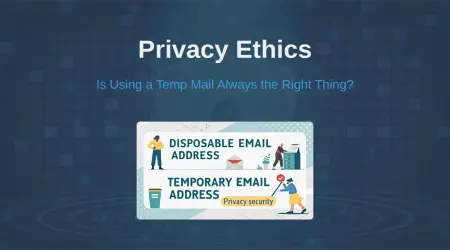
Disposable Email Addresses (DES) protect privacy and shield the primary email from spam, significantly reducing overall exposure to potential data breaches.17 By utilizing a temporary email service for non-essential or low-trust interactions, the digital nomad establishes a defensive partition. This strategy intentionally degrades the quality of correlation data available to AI scrapers. When an attacker scrapes credentials associated with a temporary email, they cannot reliably link that ephemeral identity back to the user’s high-value professional accounts. This intentional data starvation forces the AI attacker to fall back to generic, bulk phishing attempts, which are easily detected by modern filters.18
Enhancing Transactional Security with Ephemeral Identity
Beyond simple spam avoidance, DES provides enhanced transactional security. It is highly effective for processes that require a one-time verification, such as initial sign-ups or retrieving single-use coupons, especially in transient locations.17 The temporary address receives the required verification code or OTP and can then be instantly discarded. This prevents that service’s login credentials from being subsequently linked to the user's identity during a future data breach or credential stuffing attack, providing a clean, ephemeral layer of security. The benefits extend far beyond just avoiding spam, encompassing comprehensive digital privacy management in a highly exposed environment. Explore the full range of benefits to understand how this strategy fits into a robust security posture [Internal Link: https://tempmailmaster.io/post/top-7-undeniable-benefits-of-using-a-disposable-email-today-with-tempmailmaster-io].
The implementation of these disposable components defines the modern security toolkit for the nomadic professional.
Table 2: Essential Disposable Cybersecurity Toolkit for Nomads
Part III: Operational Security and Incident Response (The Human Element)
Even the most technologically robust security framework can be undermined by human error, particularly when confronted by the manipulative precision of AI-driven social engineering. Operational security for digital nomads requires rigorous protocols and continuous education.
Advanced Deepfake Verification Protocols
The psychological effectiveness of deepfake social engineering hinges on exploiting the human tendency to comply quickly with perceived authority, particularly in urgent remote scenarios.8 Defending against this requires establishing formal, mandatory verification protocols.
Establishing Out-of-Band Trust
Any request that involves high-stakes transactions—such as urgent financial transfers, immediate data access, or changes to security settings—must be verified through an established, secondary communication channel that is independent of the video or audio call itself.22 For instance, if an executive requests an immediate wire transfer via a video call, the remote employee must hang up and re-establish contact via a pre-verified channel, such as a known, trusted mobile number or a corporate-mandated, secure messaging application. This protocol ensures the request is authenticated through an avenue the attacker has not compromised.
The cognitive defense is equally important. Nomads must be trained to recognize the typical psychological triggers utilized in these scams: manufactured urgency, emotional manipulation, and overt appeal to authority.8 If the request feels unusual, inappropriate for the medium, or unduly hurried, it should be treated as suspicious and flagged for immediate out-of-band verification.
Immediate Incident Response and Documentation
In the event that a digital nomad suspects they have been targeted by a deepfake or a hyper-phishing attempt, a rapid and structured incident response plan is essential. The first step is to immediately notify corporate legal counsel, cybersecurity advisors, and the Public Relations team.22 Speed is critical to minimize damage.
Crucially, the targeted individual must preserve all evidence and documentation related to the suspected attack, as this forensic data is vital for identifying the origin of the criminal operation. Subsequent actions involve working with security partners to fortify security protocols and take down malicious content swiftly to mitigate reputational and financial damage.22
Cybersecurity Education and Compliance in a Remote Context
Technology implementation is only half the battle; the remaining 60% of top remote work threats are still classified as phishing attacks, highlighting the continuing centrality of the human decision-maker in the security chain.3
Focus on Social Engineering
Organizations must shift their training focus from generic IT security to specialized remote and social engineering awareness. By 2025, 63% of companies had created new training protocols specifically tailored for home office and remote security.3 Training must emphasize the highly personalized and contextual nature of AI-generated hyper-phishing.13 Employees must learn to analyze communications for slightly inaccurate details or context that suggests scraped public data rather than genuine, internal communication.
The Power of Updates
The global digital realm is in perpetual conflict, with software developers constantly releasing updates designed to address emerging vulnerabilities and zero-day exploits.1 Digital nomads, who frequently switch networks and rely on diverse software ecosystems, must rigorously ensure that all operating systems, applications, and security tools are constantly updated and patched.21 This continuous maintenance is a foundational pillar of device defense against newly deployed threats like the EvilAI campaigns.14 Organizations must enforce this compliance through updated security policies; 84% of organizations revised their policies to address remote work by 2025.3
Frequently Asked Questions (FAQs)
Valuable FAQs on AI and Nomad Security
Q1: Can AI Deepfakes bypass high-security Multi-Factor Authentication (MFA)?
A: Yes, sophisticated AI-driven attacks can bypass conventional MFA.5 Adversary-in-the-Middle (AiTM) attacks use automated processes to intercept session tokens after authentication, rendering basic MFA codes (SMS/TOTP) useless.5 Furthermore, biometric MFA is vulnerable to injection attacks, where synthetic or altered data is fed directly into the system, bypassing the camera and passive liveness checks entirely.10 Robust defense requires phishing-resistant MFA, such as FIDO2 hardware keys or proximity verification systems.16
Q2: How does using a temporary email address stop an AI hyper-phishing attack?
A: Using a temporary email service is a form of digital minimization.17 AI models used for hyper-phishing rely on correlating vast amounts of personal data scraped from public sources and low-security breaches to craft highly personalized messages.13 By using a disposable email address for non-essential services, the user fragments their digital identity, starving the LLMs of the necessary high-quality correlation data that links their low-value, exposed accounts to their high-value professional identity. This lack of context forces the attacker to rely on generic, less effective bulk phishing.18
Q3: What makes public Wi-Fi dangerous, even with a strong VPN?
A: Public Wi-Fi is inherently risky due to the prevalence of Man-in-the-Middle (MiTM) attacks, eavesdropping, and a general lack of strong encryption.1 While a strong, always-on VPN provides essential protection by encrypting all data traffic through a secure tunnel, it cannot protect the device itself from malware.1 Digital nomads remain vulnerable to device-level threats, such as the EvilAI campaign, which distributes malware disguised as seemingly legitimate AI productivity applications.14 Comprehensive protection requires both a VPN for network security and rigorous Endpoint Detection and Response (EDR) for device security.
Q4: Is it better to rely on biometric verification or a hardware security key (FIDO2)?
A: For robust protection against remote AI threats, a hardware security key (such as FIDO2) is generally considered superior to biometrics alone.16 Hardware keys rely on unphishable cryptographic proofs of presence and are highly resistant to session token theft (AiTM), functioning even in a Zero Trust environment. While biometrics offer convenience, they are increasingly susceptible to digital injection attacks where synthetic media is fed directly into the verification pipeline, rendering them vulnerable against sophisticated, high-risk adversaries.11
Q5: What are the tell-tale signs that a remote meeting or email request might be an AI deepfake or hyper-phishing attempt?
A: In high-stakes remote meetings, be wary of requests characterized by intense urgency, unexpected changes in financial instructions, or appeals to authority demanding immediate action.8 Visually, deepfakes may show unnatural eye movements, poor synchronization between audio and video, or slight pixelation around the face or lighting that looks "off".8 For emails, while they are often highly personalized (hyper-phishing), look for subtle inaccuracies in personal details or language that might indicate scraped rather than genuinely sourced information.13 The safest action is to immediately initiate an out-of-band verification protocol for any suspicious or high-impact request.22
Conclusion: The Future of Remote Work Security
The digital nomad lifestyle, defined by freedom and flexibility, is simultaneously defined by a severe, constantly escalating cybersecurity challenge. The rise of Generative AI has dramatically accelerated the sophistication, scale, and targeting of cybercrime, eliminating the skill barriers for threat actors and turning unsecured remote credentials into multi-million dollar liabilities.
Securing the modern remote worker in 2025 is an exercise in architectural layering, moving decisively away from perimeter-based defenses toward identity control and verification. The successful strategy is built upon three non-negotiable pillars:
- Mandatory Zero Trust Verification: Every access request must be authenticated and authorized, regardless of the user's geographical location, supported by rigorous ITAM and strong BYOD frameworks.
- Phishing-Resistant Authentication: The immediate migration from legacy, phishable MFA (SMS/TOTP) to advanced solutions like FIDO2 hardware keys and proximity-based verification is essential to counter advanced AiTM automation.
- Strategic Digital Minimization: Implementing disposable cybersecurity components, particularly the strategic use of temporary email services, is critical for starving AI threat models of the high-quality personal data necessary to launch successful hyper-phishing and social engineering attacks. By intentionally fragmenting and minimizing their digital footprint, nomads degrade the attacker's primary reconnaissance advantage.
The freedom of remote work must be balanced by the responsibility of perpetual vigilance and the adoption of adaptive, disposable security technologies. Only through this layered and proactive defense matrix can digital nomads truly safeguard their credentials and the integrity of their organizations against the exponential threat of Generative AI.
Written by Arslan – a digital privacy advocate and tech writer/Author focused on helping users take control of their inbox and online security with simple, effective strategies.